Login
Digital sovereignty means being able to use digital technologies in a self-determined, secure and informed manner. This includes knowing to whom you are entrusting your data and which providers you may, unwittingly, be committing yourself to for the long term. A person is considered sovereign if they have a choice and are not entirely dependent on a single provider or a particular technology.

Big Tech companies and their influence
Many digital services are provided by a small number of large companies. The largest at present are Alphabet (the group behind Google), Meta (which includes, for example, Facebook, Instagram and WhatsApp), Microsoft, Apple and Amazon (measured by their market capitalisation). They are all US-based, collect vast amounts of data on their users and are referred to as ‘Big Tech’ or the ‘Big 5’.
Here are some examples – you’re bound to use some of them:
- Operating systems (e.g. Windows, Android, iOS/macOS)
- Search engines (e.g. Google, Edge and Bing)
- social networks and platforms (e.g. Facebook, Instagram or LinkedIn)
- Communication services and messengers (e.g. WhatsApp, Teams or Skype)
- Office software (e.g. Microsoft Office)
- Cloud services (e.g. Google Drive and MS365)
- other useful services and platforms (e.g. Amazon, Audible, Alexa, YouTube, Google Maps, Outlook, Gmail, …)
The services offered by big tech companies are often practical and useful, but should not be used entirely without careful consideration – this is where digital sovereignty comes into play. Here are some points to bear in mind:
Dependency:
A company may change its prices, terms of use or technical standards. A foreign service – such as a computer programme or a smartphone app – may also be restricted or discontinued for certain users or in certain regions for political reasons – and this happens regularly. For example, the US government has, on several occasions, banned the use of US software in other countries or drastically increased the costs of using it in order to exert political pressure. If a service you’ve been using for years suddenly starts charging a fee or changes its rules, there’s little you can do about it. The best way to protect yourself is to consider alternative apps or programmes right from the start.
Less competition and innovation:
When a small number of companies dominate key markets, it becomes more difficult for European suppliers to develop competitive alternatives. As a result, political or economic conflicts outside Germany can also have tangible economic consequences here: supply bottlenecks lead to production delays, higher prices and, in some cases, job losses. However, for there to be a greater focus on the development of German or European products – particularly software – there must also be sufficient demand – and that’s where you come in: If you’re willing to use products that may be a little unfamiliar or sometimes come at a cost, but which haven’t been produced by large corporations, then you’re not only strengthening your own digital sovereignty, but also that of society as a whole.
Loss of control and autonomy:
When sensitive data is processed by private companies, you need to ask yourself who actually has access to it and under what legal framework the data is being processed. In the US, for example, data protection laws are not as strict as they are here. Furthermore, the US government has the means to access data on a wide scale: The US CLOUD Act allows US authorities, under certain conditions, to access data held by US companies – even if it is stored on German servers. Digital sovereignty means, amongst other things, that you exercise your right to informational self-determination and, to a large extent, decide for yourself who is allowed to access your data.
Restriction on freedom of action:
Once people have got used to a particular service, they usually do not switch to other services unless they absolutely have to. Data, contacts or purchased content are often tied to that service, and switching usually involves technical hurdles as well as a significant time commitment. Corporations benefit from this loyalty: Experts refer to this as ‘vendor lock-in’. This strong dependence is particularly problematic when public authorities rely on foreign cloud, software or communications services. This is because, if these services are discontinued or restricted for Germany, a swift switch to other systems is usually out of the question. In the worst-case scenario, entire sections of critical infrastructure could collapse. [1] So far, many German public authorities are still finding it difficult to turn their backs on US providers, but individual federal states, such as Schleswig-Holstein, are already working to make their administration less dependent. [2] In your private life, you are personally responsible for your important records; you should therefore always store your most important documents in several places to remain capable of acting and maintain digital sovereignty.
Risks relating to data protection and security:
When using digital services, you should always be aware of what data they ask you to provide and to whom it is passed on. Using secure passwords and login methods is very important in this regard. Overall, it’s always worth looking for alternatives that don’t collect large amounts of data in the first place. Digital sovereignty means not only seeing through the tricks of criminals, but also avoiding data collectors.
Impact on democracy and the formation of public opinion:
Through their algorithms, major platforms play a key role in determining what information people see. Those who control these platforms wield considerable social power – for example, over the visibility of political content or the spread of disinformation. The short-form messaging service X (formerly Twitter) has also seen millions of users and organisations leave since 2022 because disinformation and far-right content were increasingly being deliberately disseminated there. Digital sovereignty means not only recognising manipulation through algorithms, but also consciously seeking out alternatives.
Alternative services (a selection)
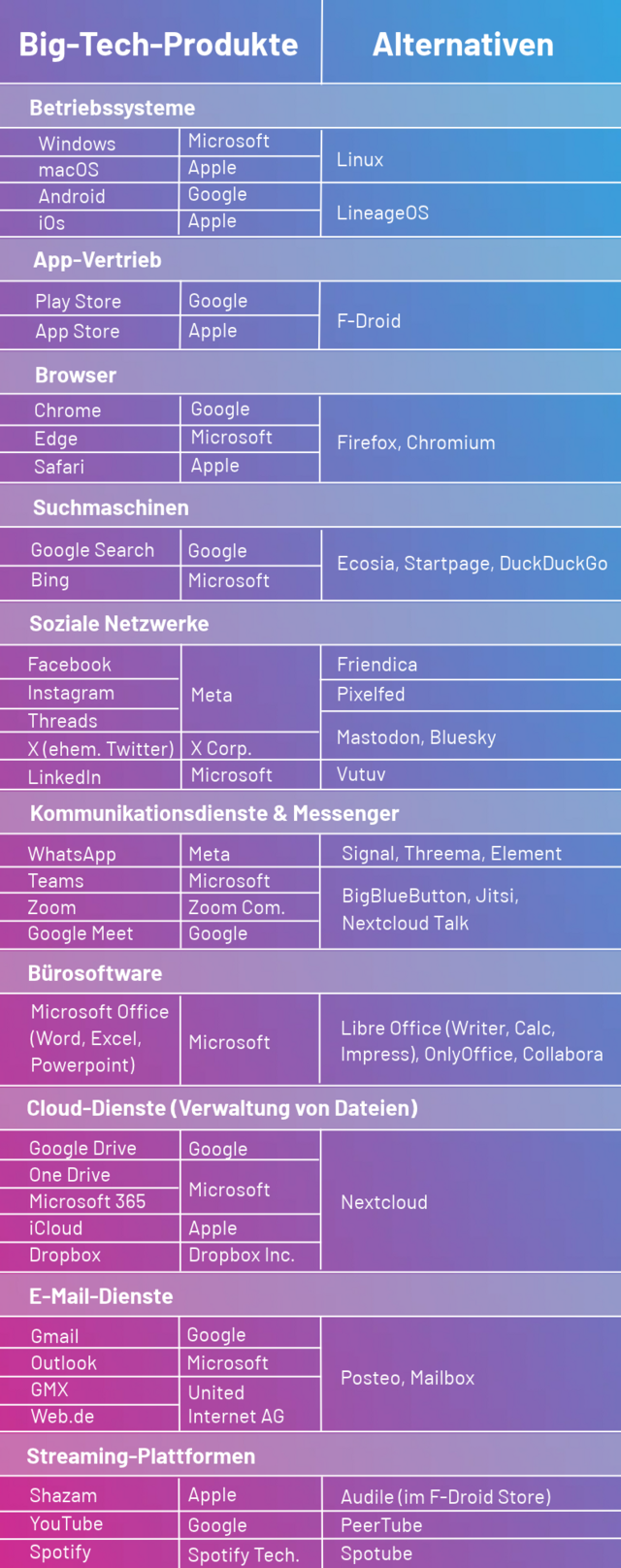
Switching to alternative services isn’t always easy. A very well-known example is the use of the WhatsApp messaging app. The vast majority of users are now aware that the app, which is owned by the Meta Group, collects a great deal of personal data and also accesses all the phone numbers (along with names) stored on smartphones. [3] Switching to other messaging apps is tricky, because if you want to stay in touch with all your contacts, they’d all have to switch to a different app at the same time.
Tip: Take a two-pronged approach to start with! You can leave WhatsApp installed for the time being, but also install a second messaging app, such as Signal or Threema, which are more privacy-friendly. Then only use WhatsApp with the contacts you can’t reach any other way.
It’s also easier for each individual if a whole group switches to a different messaging app together – for example, the whole family, a school class or a sports club – so why not suggest this to the people around you?
Most people use the well-known products from the big tech companies because everyone else uses them and alternatives are often not widely known. This is only to be expected, as the big companies have far greater opportunities and financial resources to promote their products. But you might be one of those people who know a few alternatives and perhaps dare to try something new every now and then. There are alternatives to almost every commercial programme offered by the big tech companies.
In this overview, we’ll show you programmes, providers and possible alternatives. Why not give them a go?
What can I do myself?
Digital sovereignty starts with each and every individual and in our own daily lives:
- Find out about alternative programmes and don’t put all your eggs in one basket
- When using new apps, check what data they require before you install them
- Share your data consciously and reveal as little about yourself as possible
- Make local backups of your data
- Stay alert to unusual messages, links or payment requests
- Break out of your comfort zone and try out alternative programmes
- Pass on your knowledge to friends, children, grandchildren or neighbours so that they can learn to use digital services safely and independently.
Boost your digital literacy and learn more with #DigitalCheckNRW.

Useful overviews
Digitalcourage e.V.: Which service belongs to which provider? https://digitalcourage.de/digitale-selbstverteidigung/wer-gehoert-zu-wem
#UnplugBigTech: Your roadmap to a freer digital life (Mike Kuketz): https://www.kuketz-blog.de/unplugbigtech-dein-fahrplan-fuer-ein-freieres-digitales-leben-teil-1/
SwitchingSoftware (in English): https://switching.software/
Free School Software Network – Alternative programmes in the education sector (Digitalcourage e.V.): https://digitalcourage.de/netzwerk-freie-schulsoftware
Conclusion
Digital sovereignty doesn’t just start with politics or large public authorities. It also begins in your own everyday life, and you have more options than you might think. You can be mindful of which digital services you use, what personal data you disclose, and whether you’re making yourself dependent on a single provider. Strong passwords, regular data backups and a conscious approach to apps and online services are just as important as a willingness to explore alternatives. At the same time, digital sovereignty is a societal responsibility. You don’t need to become a computer expert. Above all, digital sovereignty means not accepting everything without question, asking questions, being aware of alternatives and, where possible, being able to make your own decisions.